
🧠 Neural Dispatch: Google’s Disco browser, Windows 11’s stumbling dreams and reality check of job losses
The biggest AI developments, decoded. December 17, 2025

Hello!
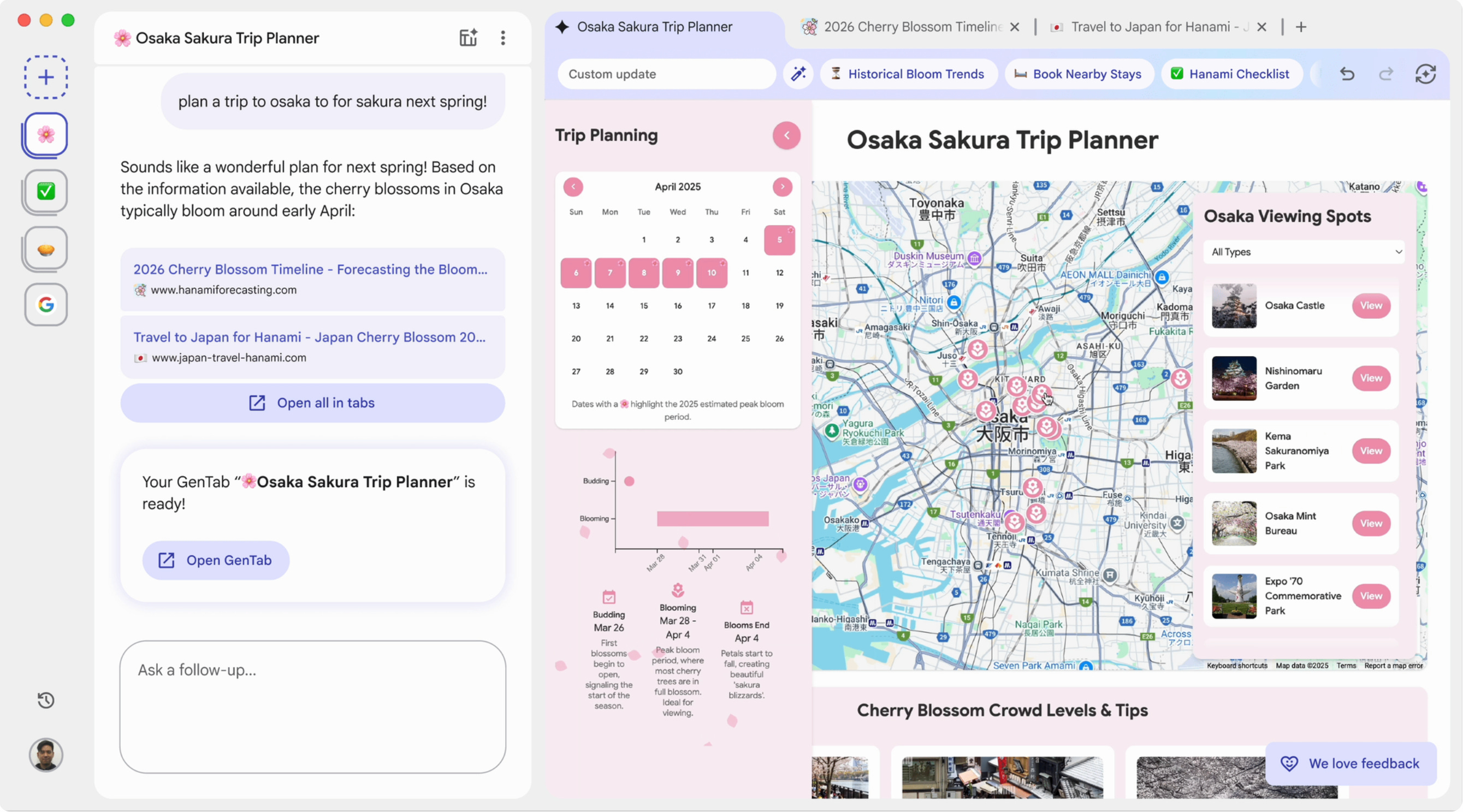
Cognitive warmup. Google is building a new web browser. Yes, you read that right. For now, the plan is this remains filed under “experimental” and this isn’t going to replace Chrome anytime soon. But for those of you who want to try it, the browser is called Disco (not the party mood, but short for discovery) and its key feature is something called GenTabs. Google says these are “generated based on your specific tabs and your specific goal”, and these tabs essentially morph into interactive web apps within the browser. Trip planning, diet plans, exploring a topic and build plans, are some strengths Google highlights. I’d expect this to heavily rely on the recently launched Gemini 3, which can create interactive layouts based on user prompts.
ALGORITHM
This week, we have a conversation about Microsoft’s Windows 11 struggles (because of the AI obsession), OpenAI’s legal wrangle, and Satya Nadella admits something most AI companies won’t (but we already knew).
OpenAI’s trouble with authors
OpenAI is getting hit with some more legal trouble. The AI company, this month, lost a key discovery battle over internal communications related to deleting two huge datasets of pirated books, used for model training. They must now hand over internal chats about deleting two huge book-laden datasets. It certainly makes it easier for authors to argue wilful copyright infringement and push for very high statutory damages per book. For context, OpenAI is being sued by authors who say the company trained its GPT models on datasets of pirated books. In another similar case, AI company Anthropic earlier agreed to pay $1.5 billion to settle a similar content lawsuit.
The thing is, if those communications indicate OpenAI knew the data was illegally obtained and made attempts to erase the proof, authors and publishers have a much stronger case to work with and OpenAI cedes ground towards a much weaker legal position. Authors have long argued before U.S. District Judge Ona Wang, that pirated books and books obtained from shadow libraries have been used by AI companies including OpenAI, for training purposes. Earlier, OpenAI had told the court that the datasets were removed for non use, then later tried to say that anything about the deletion was privileged. Of course, the AI company believes they didn’t do anything wrong. AI is never wrong, is it?
Power guzzlers, but with confidence…
At least someone’s admitting this. Microsoft CEO Satya Nadella acknowledged that data centers are “putting a lot of pressure” on power grids. Secondly, he says the tech industry “needs to earn the social permission to consume energy” for AI data centers. Hasn’t that ship sailed already, Satya? In an interview recently with Axel Springer CEO Mathias Döpfner, Nadella also called for faster permissions for new power infrastructure and “innovation” in energy efficiency and generation. Of course Nadella also downplayed the immediate impact of AI on power consumption, but does warn that the public will accept this pressure only if it “results in economic growth that is broad-spread in the economy.” Can a hype machine (would you classify this as a runaway train now?) like AI ignore economic and infrastructure fundamentals? Unlikely.
Microsoft’s agentic OS dreams stumble
I had asked a simple question a few weeks ago — does anyone at Microsoft even use Windows 11? For all the hype and insistence that AI overbearance is the way forward and that Windows must become an “agentic OS”, it turns out users aren’t as impressed as investors and board members hoped they’d be. Dell, one of Microsoft’s most important PC partners, indicates that as many as 500 million PCs worldwide that are capable of running Windows 11, are still on Windows 10. Users simply aren’t upgrading. “We have about 500 million of them capable of running Windows 11 that haven’t been upgraded,” said Dell COO Jeffrey Clarke, during the Q3 earnings call. This, despite Microsoft marking the end of life for Windows 10, hoping that’d get used to upgrade. First, they clearly have forgotten how long users held on to Windows XP. Secondly, PC makers clearly don’t like the Copilot, AI and ‘agentic’ complexities, which are easily avoidable. If the PC market is flat next year, don’t be too surprised.
THINKING
“It takes about $80 billion to fill up a one-gigawatt data center. That’s today’s number. If one company is going to commit 20-30 gigawatts, that’s $1.5 trillion of CapEx. You’ve got to use it all in five years because at that point, you’ve got to throw it away and refill it. Then, if I look at the total commits in the world in this space, in chasing AGI, it seems to be like 100 gigawatts with these announcements. That’s $8 trillion of CapEx. It’s my view that there’s no way you’re going to get a return on that because $8 trillion of CapEx means you need roughly $800 billion of profit just to pay for the interest.”
— Arvind Krishna, CEO of IBM, in an interview
I am sure the AI companies will find a way to recalculate the calculations and somehow make it look like they’re working. But for now, Arvind Krishna didn’t offer a hot take — he offered a calculator. And the math is… bleak (to put it mildly). A one-gigawatt data centre now costs $80 billion to stand on its feet (or neural processing, whatever you think works). The AI giants are talking about 20–30 GW each, which works out to $1.5 trillion per company. And because hardware obsolescence moves faster than Silicon Valley buzzwords, you have to essentially throw the whole thing out in five years (there is a raging debate, with the likes of Nvidia calculating this at 6 years, perhaps to make numbers look better) and start again. Combine all the global AGI chest-thumping, and the market is now staring at 100 gigawatts of commitments — and that is roughly $8 trillion in capex. For reference, that’s more than roughly the size of the entire global retail industry.
A Reality Check: Krishna’s warning, in an interview with The Verge, lands hard because it cuts through the collective hallucination. An $8 trillion capex base requires roughly $800 billion in annual profit just to repay interest. No one — not Nvidia, not OpenAI, not even trillion-dollar hyperscalers — currently generates anything close to that from AI products alone. Not even in their most optimistic investor decks. Yet the rhetoric continues. Nvidia insists infinite compute growth is destiny. OpenAI is out raising capital like they’re building a second Panama Canal. Microsoft is promising an AGI future while quietly reminding shareholders to focus on long-term value. Google is trying to do something certainly better, at the intersection of science (and that holds it in better stead compared with others). The broader attempt is to outrun both physics and common sense as well as basic math.
If this keeps going unchecked, which it likely will, the AI industry isn’t just inflating a bubble that’ll eventually explode in our faces, but it’s inflating a leveraged, amortising, electricity-backed super-bubble with a rolling five-year expiry date. A bubble that demands that the capital market keeps nodding politely, shovels more and more money in the direction of the AI bros, while pretending compound interest is optional. Who’ll foot the bill when it’s all done and dusted? The taxpayers worldwide, of course.
The uncomfortable truth is this — business models simply don’t justify the infrastructure demands (and perhaps never will), and physics doesn’t have any obligation to respond to venture capital enthusiasm. At some point, someone will need to admit the obvious. That you can’t brute-force AGI by setting money on fire. And when reality catches up, it won’t be AGI that breaks, it’ll be balance sheets. And the taxpayers’ backs.
Neural Dispatch is your weekly guide to the rapidly evolving landscape of artificial intelligence. Each edition delivers curated insights on breakthrough technologies, practical applications, and strategic implications shaping our digital future.